Sail the Banda Sea crossing: Sep-Nov hammerhead season, Banda Neira spice heritage, a day-by-day Raja Ampat-Komodo route and rates verified August 2026.
The Banda Sea crossing is Indonesia’s great blue-water voyage: a one-way passage of ten to fourteen nights linking Raja Ampat with Komodo through the original Spice Islands. The window is strictly seasonal — September to November for schooling hammerheads, with a second calm window in March and April — and departures exist only because the charter fleet repositions between the two cruising grounds. Booked as an expedition charter, it combines the region’s most storied heritage islands with some of its wildest open-water diving, all planned end-to-end by our concierge team in Bali.
September to November is the prime window, when schooling hammerheads gather along the Banda walls and the sea between Maluku and Flores settles into its calmest stretch of the year. The timing is no accident: most large yachts cruise Raja Ampat from November to April and Komodo from May to October, so crossings run when the fleet repositions between the two.
Because each yacht makes the passage at most twice a year, Banda Sea departures are among the scarcest charters in Indonesia. For peak-adjacent dates, plan to book nine to twelve months ahead.
Most crossings run ten to fourteen nights one way between Sorong and Labuan Bajo, threading Misool, the Banda Islands and the remote volcanic arc before landfall in Alor and the Flores coast. The sample below reads west-bound; in October and November the same legs simply run in reverse. Many guests bolt the crossing onto a Misool charter or continue into a full Raja Ampat to Komodo crossing program.
| Leg | Days | What happens |
|---|---|---|
| Sorong & Misool | Days 1–3 | Embark at Sorong harbour; last Raja Ampat dives at Balbulol and Magic Mountain (Shadow Reef) before open water. |
| Koon & eastern Seram | Day 4 | Reef walls and fish aggregations at the gateway to the Banda Sea proper. |
| Banda Neira | Days 5–6 | The heritage heart of the voyage: nutmeg groves, colonial harbourfront, fort walls above the caldera anchorage. |
| Hatta, Ai & Run | Days 7–8 | Sheer drop-offs and blue-water walls where hammerhead schools patrol in season. |
| Volcanic arc (Manuk, Serua) | Days 9–10 | Uninhabited seamount islands far from any port — seabird colonies, sea snakes, pelagic action. |
| Alor & Pantar | Days 11–12 | Current-swept ridges and traditional villages as the route rejoins the island chain. |
| Flores coast to Komodo | Days 13–14 | Final legs along Flores into Komodo National Park; disembark at Labuan Bajo. |
From September to November, scalloped hammerheads school along the walls of the outer Banda Islands, and the crossing becomes one of the few charter itineraries anywhere built around the encounter. This is open-ocean diving in its purest form: deep blue water, long walls, and sites that see a handful of boats a year. It is a different rhythm from the reef-rich intensity of Raja Ampat — whose seascape holds more than 1,700 fish species and 550 coral species according to scientific surveys of the Bird’s Head region — and the contrast is exactly the point. You begin the voyage in the richest reefs on earth and end it, days later, staring into blue water waiting for shadows to resolve into hammerheads.
Conditions favour experienced divers: exposed sites, occasional current, and long passages between anchorages. Our concierge matches the vessel, guides and route to your logbook before anything is confirmed.
For centuries these tiny islands were the world’s only source of nutmeg, and the architecture of that monopoly still stands. Banda Neira’s streets keep their colonial facades and shaded plantation houses; Fort Belgica looks down over the harbour where spice fleets once anchored; and tiny Run — famously traded to the Dutch in exchange for Manhattan — sits on the horizon like a footnote that changed the map of the world. A heritage day here, walking nutmeg groves with the smell of mace drying in the sun, is the emotional centre of the crossing and the reason we never compress Banda Neira into a half-day stop.
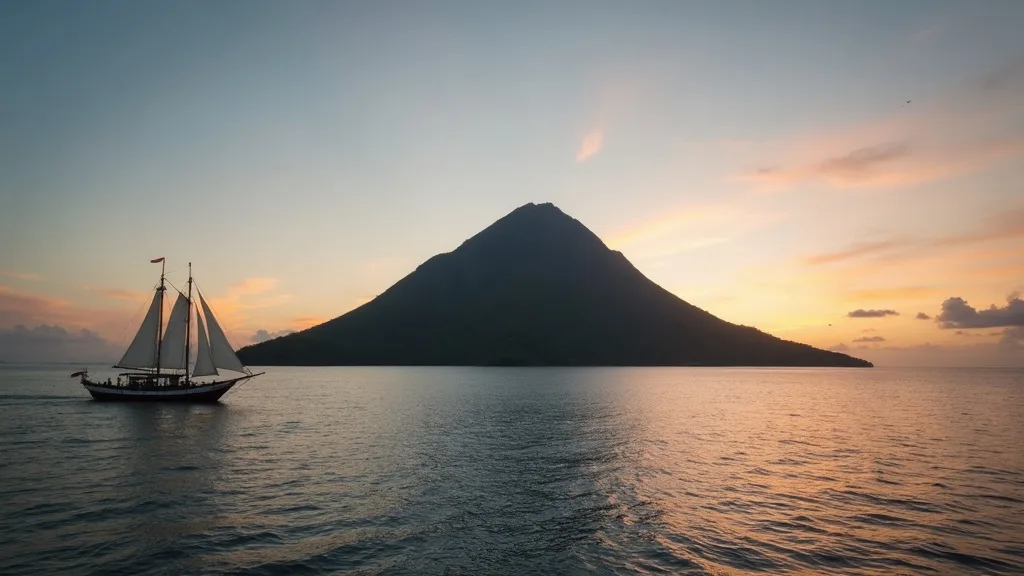
A crossing has a rhythm no loop itinerary can match. There are genuine passages here — long afternoons where the horizon is empty in every direction, flying fish scatter off the bow, and the only decision is whether to read on the foredeck or nap in the shade of the mainsail. Crews structure sea days deliberately: late breakfasts, spa or massage blocks on vessels that carry therapists, chart-table briefings on the next island group, and dinners timed to open-ocean sunsets. Photographers get drone windows over uninhabited volcanic cones; children get knot lessons and dolphin watches. Then an island appears — perhaps uninhabited Manuk with its wheeling seabirds — and the expedition tempo snaps back. Guests consistently describe the sea days not as transit but as the point: the rare luxury of being genuinely unreachable, comfortably.
Whole-boat rates follow the same bands as a Raja Ampat charter, with fuel and repositioning expenses itemised on top for one-way routings. Rates verified August 2026; see the full Raja Ampat yacht charter cost guide for band-by-band detail.
| Vessel class | Indicative rate |
|---|---|
| Entry phinisi (whole boat) | from ~$1,500 per night |
| Mid-luxury yachts | from ~$4,500 per night |
| Premium phinisi | $6,000–10,000 per night |
| Flagship class | $12,000–16,000 per night |
Selected liveaboards also sell crossing departures by the cabin from around $350 per night per person — a rare, cost-effective way to make the passage without chartering the whole vessel.
Start with the season, not the boat. Tell us your direction and month, and our Bali-based concierge — part of the Raja Ampat Yacht Charter desk operated by Komodo Luxury since 2015 — matches you to the vessels actually making the crossing that window. We then handle everything end-to-end: flights into Sorong or Labuan Bajo (Sorong is around four hours from Jakarta), marine park permits and village fees, provisioning, dive guides and documentation, so the only decision left on board is which side of the deck to watch the sunset from.
Plan my charter: message our concierge on WhatsApp +62 811-3810-8110 or email sales@komodoluxury.com for live crossing availability and a tailored Banda Sea itinerary.
Have a Question on This Topic?
Our concierge team is in Sorong, on-island for most of the year. Forward this page along with your specific question — we will reply with an answer grounded in what we have actually seen on the water.